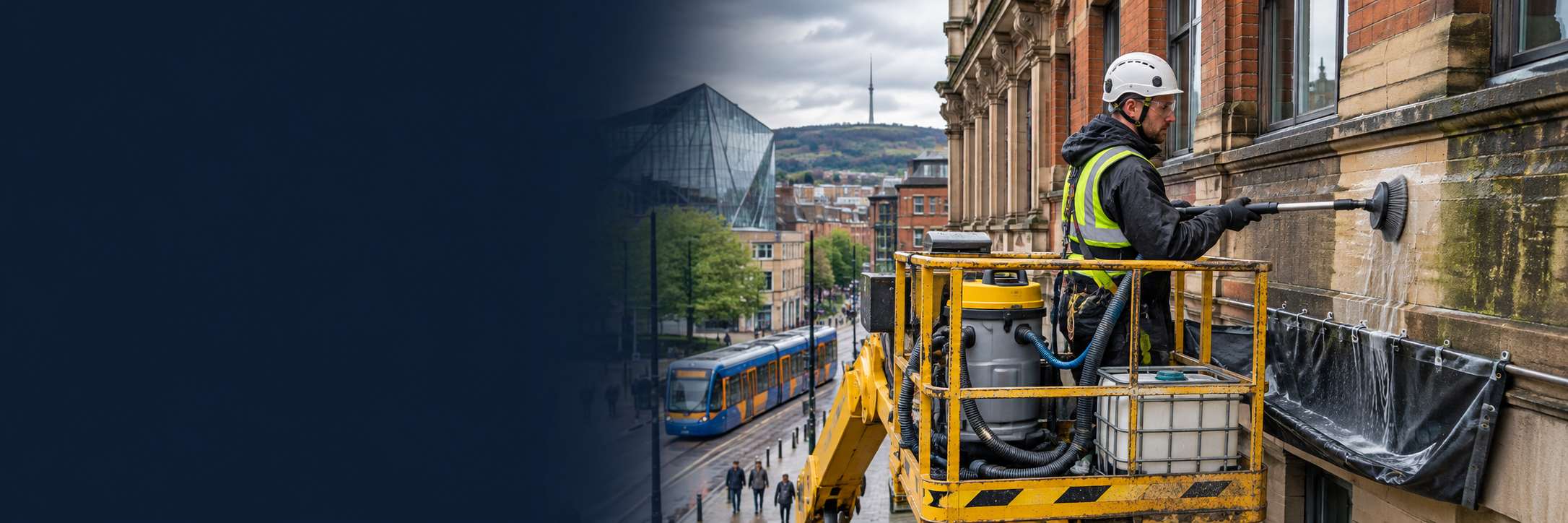
Façade cleaning in Sheffield and South Yorkshire
Look at where a dark band begins on the wall. A streak below one sill suggests a different starting point from a line of grime across an entire shopfront. For a Sheffield façade cleaning enquiry, a wide photograph of the elevation and a closer view from safe ground help us decide where a small trial would be informative.
A façade plan begins with the wall material
Façade cleaning in Sheffield begins by identifying what the wall is made of and how it has been altered. Sandstone, brick, render, painted masonry, metal cladding and glazed sections do not respond alike to water, abrasion or detergent. A building may combine several finishes within one elevation, with older mortar beside newer repointing and painted details beside uncoated stone. We ask for clear photographs of each elevation and any known repairs before recommending a visit. Dark streaks beneath a sill, green growth on a shaded wall and traffic deposits near a busy road have different causes. The safest effective method is chosen only after the surface and the contamination have been assessed. We explain which marks may remain because of permanent weathering or earlier damage, and agree a test area where uncertainty warrants it.
Brickwork and mortar need measured treatment
Sheffield terraces, commercial frontages and former industrial buildings often have brickwork whose appearance depends on the age and condition of the mortar. Hard scrubbing or excessive pressure can erode weak joints and open a route for water. We look for loose pointing, salts, spalling, painted patches and staining associated with leaks. If a repair is needed, cleaning alone will not resolve the underlying issue. A controlled trial helps determine whether a deposit can be lifted without altering the brick face. The cleaning sequence is designed to limit saturation, protect openings and capture run-off where required. Owners should tell us about previous chemical treatments or repointing. These details affect compatibility and can explain why neighbouring areas respond differently even when they look similar from the street.
Stone, render and painted surfaces require distinct methods
Natural stone can be porous and easily discoloured by an unsuitable product. Render may retain algae in its texture, while painted walls can lose adhesion if the coating has already failed. We inspect visible cracks, hollow areas, efflorescence and coating condition before suggesting a technique. The aim is to remove appropriate surface deposits without trying to clean away a structural or moisture problem. On a mixed façade, we may divide the work into zones and adjust tools, dwell times and rinsing. A small test in a discreet position can show the likely finish, especially on pale stone or a weathered painted wall. When a surface is too fragile for a satisfactory cleaning result, we explain the limitation and suggest that the owner seek a repair or coating assessment before work proceeds.
Algae, atmospheric grime and local exposure
A wall can appear dirty for several reasons. Shade and persistent moisture favour organic growth, while roads and industrial activity can leave darker particulate deposits on exposed elevations. Rust from fixings, water trails from gutters and staining beneath ventilation outlets need separate investigation. Cleaning can remove some surface matter, but a failed downpipe will keep marking the wall until it is repaired. We therefore ask where staining begins, whether it changes after rain and if it has spread recently. Photographs in dry daylight are useful. A proposal can distinguish general façade washing from targeted treatment of specific marks. We avoid broad promises about complete stain removal, since weathering, absorbed colour and historic coatings may have changed the material itself. A practical maintenance recommendation addresses the cause as well as the visible result.
Access from narrow streets to larger premises
The access method is an essential part of façade work. A terraced property in Crookes may have limited pavement width, a shopfront around Fargate may have pedestrian traffic and a warehouse in Tinsley may need work planned around loading bays. We consider working height, ground conditions, nearby doors, overhead services and the ability to protect the public. Equipment is selected for the building, rather than assumed from the number of storeys. Work at height is planned and supervised, with a suitable safe working position. If a proposed arrangement cannot be used, we revise the scope before cleaning starts. Weather, especially wind around exposed elevations, can affect both access and the control of spray. Occupants and neighbouring businesses need clear information about when a section of wall or path may be temporarily unavailable.
Windows, seals, signage and planted areas
The surface adjoining a wall can be more vulnerable than the wall itself. Window seals, vents, external lights, signs, cameras, electrical outlets and planted beds may require protection or a different cleaning direction. We identify what can be isolated, what should remain dry and what must be excluded. Rainwater goods are checked for obvious defects because leaking joints can cause renewed streaking. On a commercial frontage, displays and customer access may dictate a phased schedule. On a home, an extension roof or conservatory can affect the route for equipment and debris. We discuss the practical protections in advance and inspect the ground below when the work is finished. A façade quote should tell the owner whether windows, frames, gutters, signs and paving are included, since these are separate surfaces with separate methods.
Controlled water and responsible run-off
Where water is used, its route matters. A heavy rinse can move loosened deposits towards door thresholds, basement wells, planting or surface drains. We plan containment and collection for the job, particularly where products or concentrated soiling are involved. The exact approach depends on the wall, drainage and surrounding land. A façade in a busy street may require a different setup from a detached house with private access. We do not regard run-off as someone else’s problem once it leaves the wall. Staff explain where equipment will stand and how adjacent surfaces will be protected. If a wall cannot be cleaned without unacceptable spread to a neighbouring property or vulnerable material, we pause and agree a revised method. This is part of the service specification and should be clear before the appointment.
Heritage and older buildings in Sheffield
Older brick and stone façades can contain repairs from several decades, and their appearance may be part of the character of a street. Cleaning can expose differences in colour or previous patching that were hidden by uniform grime. In conservation settings, the owner may need to check relevant permissions or advice before commissioning work. We avoid assuming that a historic wall can be treated like modern cladding. A gentle test, material specific method and realistic expectation of finish are especially important. Areas around Kelham Island, the city centre and older residential districts include a wide range of construction periods, so an address is only a starting point for assessment. Where the substrate or permission question is uncertain, the sensible next step is clarification, not a quick wash to meet an arbitrary deadline.
For a terrace with adjoining frontages, identify the property boundary and choose a test patch that represents your own wall. Previous repointing can make two adjoining bays take water differently. If staining starts directly below an overflowing gutter, arrange an assessment of the roof and rainwater outlets before booking a repeat wash of the stone.
Commercial cladding and managed elevations
Metal and composite cladding often need a programme that respects manufacturer recommendations, coating condition and the building’s operations. A large elevation may include joints, seals, service penetrations and high level signs. We agree access windows with the facilities contact, consider vehicle and pedestrian movement, and record any areas omitted because of obstructions. On industrial premises around the Lower Don Valley, Attercliffe and Doncaster, the working plan may be staged to keep an entrance open. Staff can explain the proposed method, equipment and sequence before attendance. A written scope helps managers coordinate security, deliveries and tenant notices. It should also separate routine washing from specialist stain removal or repairs. A clean appearance is valuable, but it should not be achieved by damaging a coating or interrupting essential operations.
Local coverage without generic promises
Cleaning Company Sheffield works across Sheffield, Doncaster, Rotherham and Barnsley. In Sheffield itself, requests may come from Ecclesall, Hillsborough, Handsworth, Walkley, Nether Edge and the city centre, each with different building form and access conditions. A Doncaster business park, a Rotherham retail frontage and a Barnsley terrace may all need façade care, but their equipment and scheduling requirements differ. We use the locality to plan travel and ask relevant access questions; we do not invent a fixed local method or price. For a useful first discussion, provide the postcode, wall material, approximate elevation dimensions, photographs, working height and any known defects. These details lead to a clearer assessment than a broad request for pressure washing alone.
What is included in a careful quotation
A quote should identify the elevations and materials included, the areas excluded, the cleaning technique proposed and any test condition. It should make access, water supply, protection, waste and run-off arrangements understandable. If a mobile platform, scaffold or temporary closure is required, that assumption needs to be visible. We ask whether the property is occupied, whether an entrance must remain available and if there are neighbouring surfaces that need special care. A photographic record can support the agreed scope and final review. The quote does not imply that all staining is removable or that cleaning will solve a leaking gutter, damp wall or failed coating. If additional defects are identified on arrival, the team discusses the implications before changing the work. Clear limits protect the customer from a vague promise and help schedule the correct resources.
When a wall needs repair before washing
Cleaning is not a repair for open joints, unstable render, flaking paint or penetrating damp. An affected wall may need a roofer, mason or building surveyor before a wash is sensible. We identify visible concerns during assessment and explain where the cleaning scope should stop. A small area may be excluded while the rest of an elevation remains suitable, or the whole job may need to wait. The customer should know this before access equipment is booked. Once the underlying issue is addressed, a fresh assessment can determine whether cleaning will improve the wall without increasing damage.
Preparing for façade cleaning
Before attendance, confirm who can grant access and explain any restrictions on gates, courtyards or shared paths. Move vehicles and portable items away from the work zone if asked, close windows and tell occupants when water or equipment may be nearby. Identify vulnerable planting, recent paint, electrical installations and known leaks. If a shop or office must remain open, agree the sequence for doors and entrances. The team still makes its own safety and material checks on arrival. Preparation simply reduces delays and helps avoid an avoidable conflict between the planned work and the building’s daily use. We may reschedule when wind, freezing conditions or another factor prevents safe control of equipment and spray. The right outcome is a defensible clean, not a rushed finish.
Aftercare and a sensible inspection cycle
The completed façade may show differences in age, old repairs, absorbed staining or a weathered coating. We describe what has been treated, what remains and whether a defect appears to require another trade. There is no universal interval for repeat cleaning: shade, traffic, planting, drainage and exposure all influence how quickly deposits return. Owners can watch for new streaks below gutters, vegetation near the wall and changes to painted or rendered finishes. Avoid attempting strong chemical or high pressure treatment on an uncertain surface. Early repair of a leaking joint can be more effective than repeated cosmetic washing. A practical aftercare discussion helps the owner decide when another inspection is useful and when maintenance, rather than cleaning, should take priority.
Arranging an assessment across South Yorkshire
If your building needs façade cleaning, contact us with photographs of the affected elevations and a brief description of the material, access and staining. Tell us whether roofing, solar panels, gutters or paving should be considered separately, as these tasks have different methods. We can discuss the information needed for a clear quotation and whether a closer inspection or trial is appropriate. Call Cleaning Company Sheffield on 0845 52 805 20 or use the cleaning quote form. Our operating area covers Sheffield, Doncaster, Rotherham and Barnsley, with a property specific plan for each address.
Discuss a façade cleaning quotation or call 0845 52 805 20.